Founder Notes #1: What 17 Years of Building Integrations Taught Me About AI
Clint
is a marketing entrepreneur with over 25 years of experience and has successfully grown several 7 to 8-figure businesses. He is also skilled in using NetSuite and Salesforce. Currently, running Cazoomi for over 17 years and based in the Philippines.
20 minute read
Founder Notes #1: What 17 Years of Building Integrations Taught Me About AI
Cazoomi didn’t begin with a grand plan to build an integration platform. It grew out of consulting projects, mistakes, survival and a pattern I kept seeing in board rooms: businesses were solving the same problems over and over again. Seventeen years later, AI has me thinking about those patterns again.
It’s just after sunrise as I write this from my open-air gym on a small Philippine island. My six-year-old Malamute, five-year-old Pembroke Welsh Corgi and eighteen-month-old Golden Retriever are all sleeping nearby, which is pretty much normal around here until they decide otherwise.
The birds are awake, and the roosters have been awake for what seems like hours. If you’ve spent much time in the Philippines, you know roosters don’t seem particularly concerned about whether you live in a city, on a farm or next to a small beach. They are everywhere, and apparently all of them have been assigned responsibility for announcing the beginning of each day, and every hour after that.
I have my coffee beside me and was thinking this morning about how strange it is that this is where I ended up. Seventeen years ago I couldn’t have imagined it.
Back then my days were filled with consulting projects, customer meetings, business process maps, integrations, support emails and trying to figure out exactly how to keep a very small company alive. I wasn’t sitting around thinking about building a successful SaaS company. Most of the time I was thinking about the next customer, the next project and whether whatever we were building would eventually pay all the bills.
Now AI is everywhere, and I find myself reading many of the same kinds of predictions I’ve heard during every major technology shift I’ve lived through. Everything is about to change, entire industries are going away, software will build itself, companies will need fewer people and consultants will disappear.
Maybe.
AI is certainly the most interesting technology I’ve seen in a long time. I use it myself and think it’s remarkable, but after spending more than seventeen years building integrations, I keep coming back to something much less exciting: technology changes incredibly fast, while the problems people bring into a board room change much more slowly.
That’s really what I want to write about in these Founder Notes.
I Didn’t Start Out Trying to Build a Software Company
Cazoomi really started during the financial crisis around 2008 and 2009, although I certainly wouldn’t have described it that way at the time.
I had been working at NetSuite in the Bay Area and eventually got myself into a situation where I knew my time there was probably coming to an end. I had pushed back on a couple of things I didn’t agree with, sometimes in ways I wouldn’t recommend today. I was also drinking too much and handled some of that frustration badly.
I remember knowing they were probably going to fire me.
So I quit first.
I left my laptop and walked out. I was scared that if I got fired I wouldn’t be able to find another good job, especially with the economy falling apart around us, so being able to tell the next company that I had left NetSuite seemed very important at the time.
Looking back, I can see the pattern much more clearly than I could then. When I thought a situation was going to end badly, sometimes I created the ending myself so at least I could control it, and I did that more than once in those years. At the time I didn’t call it self-sabotage. I thought I was surviving. There is probably a difference between the two, but it took me years to see it.
The Bridge Between a Job and Cazoomi
After NetSuite, I applied to one of its leading West Coast partners. That move mattered because it made my departure from NetSuite look like what I desperately wanted it to look like: a normal transition from the software company to a consulting partner. It worked, and soon I was back in board rooms helping companies implement NetSuite and other enterprise software.
I continued learning the part of the business I had always found most interesting. I liked sitting with people, listening to how their companies worked and figuring out why the software wasn’t doing what they thought it should do.
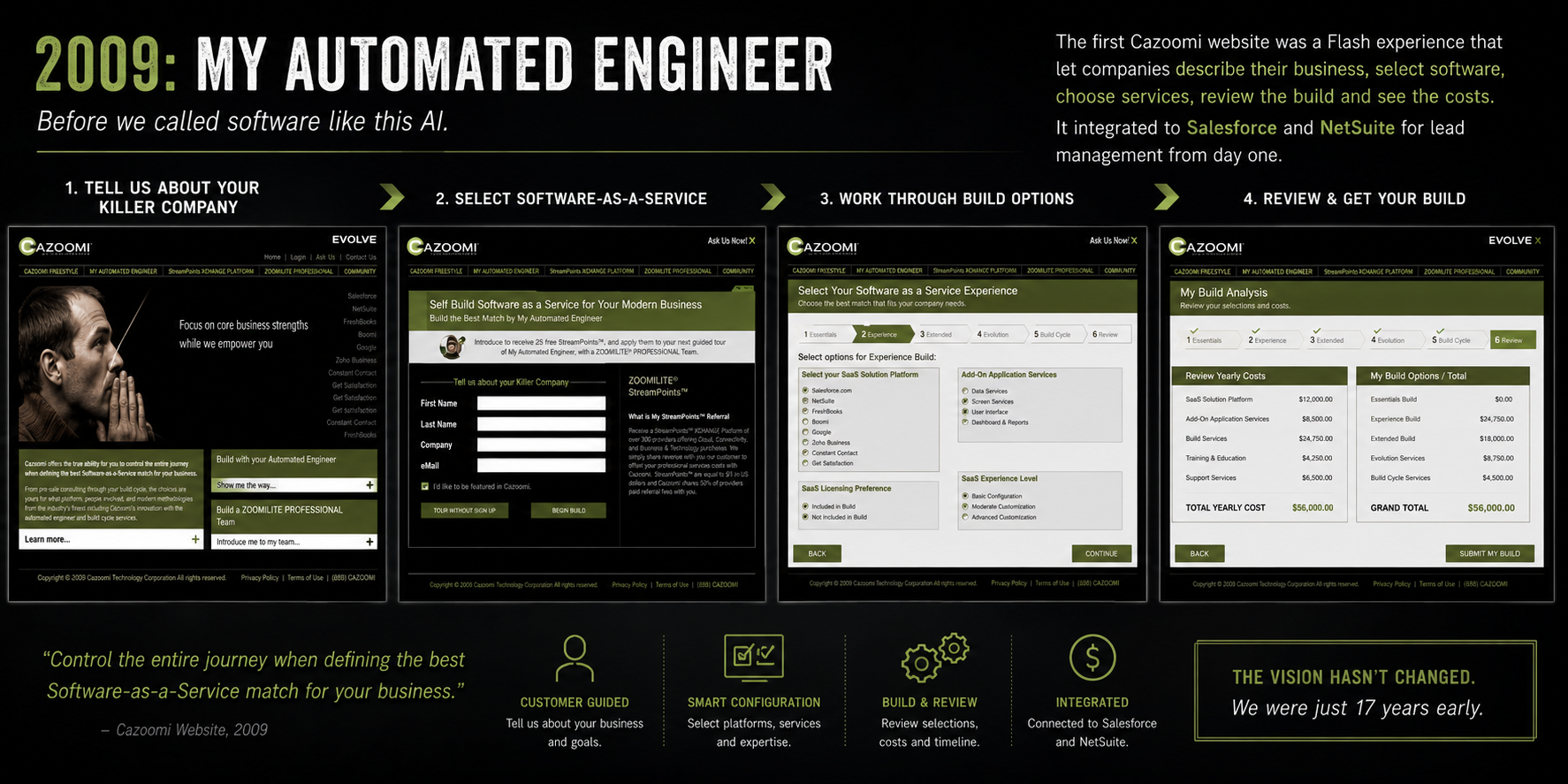
During this period I started working with a very talented designer. He could take ideas that were floating around in conversations and PowerPoint slides and make them look real. The original Cazoomi website he designed in 2009 still looks remarkably good to me today, and it made us look like a much larger company than we actually were.
We spent a ridiculous amount of our early money on the first Cazoomi website. At the time it was built in Flash and we called the main idea “My Automated Engineer.” I had worked with configurators at BigMachines and couldn’t get the idea out of my head: why couldn’t we do something similar for software and consulting?
The designer took that idea much further visually than I ever could have. A customer could describe the business, choose software, work through services and build options, review the costs and essentially configure a project. Behind it, we were even feeding information into Salesforce and NetSuite. Looking at the screenshots today is strange because the interface feels closer to what people are trying to build with AI now than to most business websites I remember from 2009.
It wasn’t AI. It was rules, workflows and a lot of expensive Flash development. But the idea underneath it hasn’t changed much: take knowledge that normally sits inside someone’s head and let software help the customer make the next decision.
That mattered because behind that beautiful website was a very different reality.
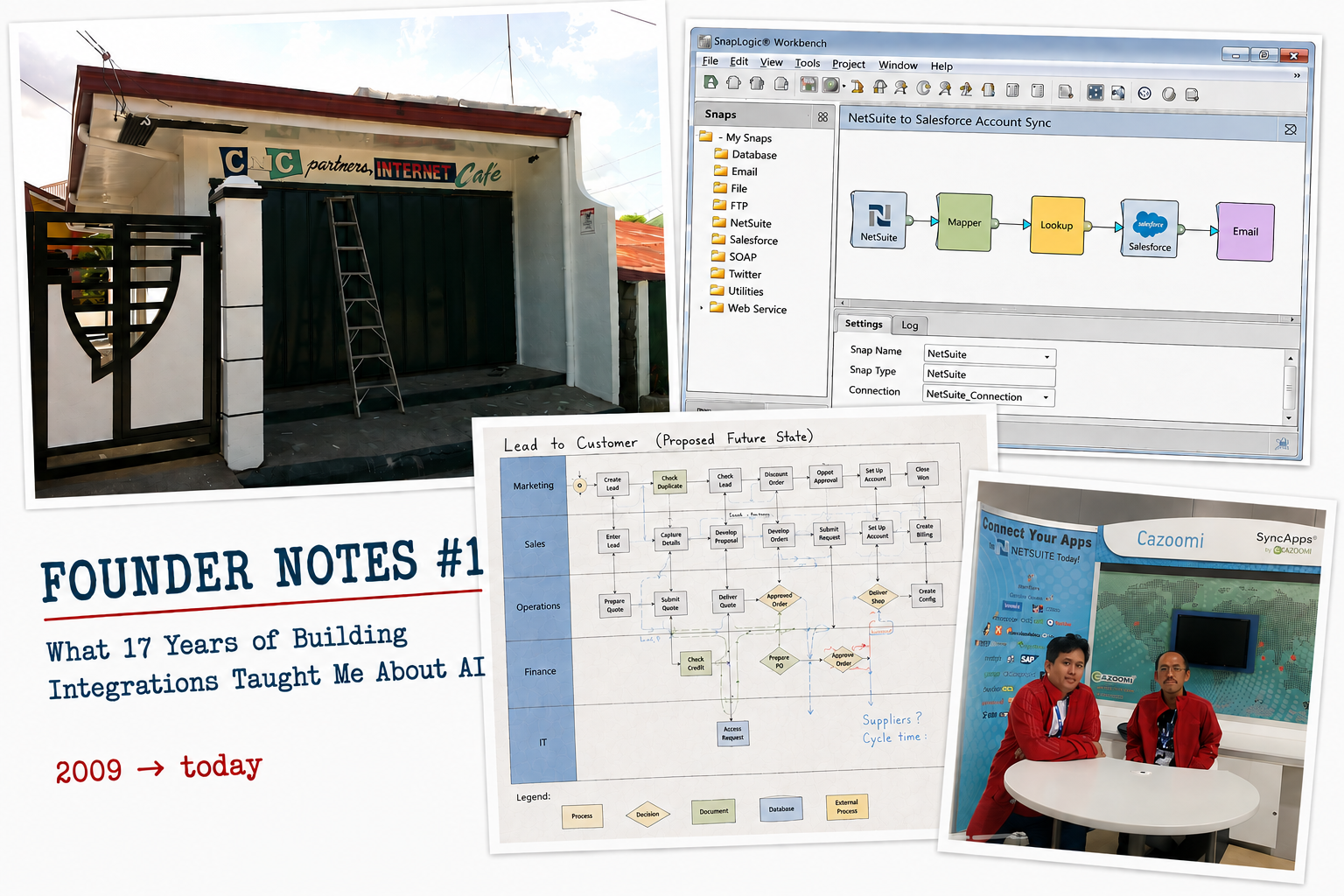
Cazoomi was originally mixed into another little business and nonprofit we were running. During the day there was a Philippine café where we tried to help local kids, while at night it essentially became a small call center supporting NetSuite and other Bay Area consulting projects we were doing. If you ever find some of my emails from those days, you’ll notice I sometimes used a cncpartners.com email address rather than Cazoomi. There wasn’t some sophisticated branding strategy behind that. We were just trying to make things work.
I took consulting work because consulting paid immediately, and I did support because support paid. We implemented SAP, NetSuite, Salesforce and almost anything else we could find that businesses needed help with. At different points I even described myself primarily as a support person because I wasn’t sure Cazoomi would ever make enough money to support my life.
That part of bootstrapping doesn’t get written about very much. People like the story where someone quits a job, starts a company and never looks back, but my experience was more like slowly crossing a bridge. One foot was in consulting because it paid the bills, while the other was in Cazoomi because I thought there might be something there. I just didn’t know when—or whether—I could safely move the other foot.
The Patterns Were Already There
What I did know was that I loved the implementation work, not necessarily the software itself. I liked figuring out the business.
I could walk into a room where Sales, Marketing, Finance and IT were all describing what sounded like completely different problems, listen for a while and eventually realize that most of them were talking about the same underlying process from different points of view. Sales might call something a lead, Marketing a subscriber, Finance a customer and IT a record, and then everyone wondered why the systems didn’t agree.
One of the projects I worked on around 2010 illustrates this pretty well. We spent our time gathering requirements, creating user stories, identifying pain points, defining acceptance criteria, ranking business value and mapping processes before worrying much about the actual technology. The phrase I kept coming back to was basically: identify the key pain points today and work on those first.
That sounds obvious now, but it wasn’t always obvious inside companies spending millions of dollars on enterprise software.
Sometimes I would sit through hours of discussion before realizing everyone was trying to solve variations of something I had already seen at another customer. It might have been a different company, industry and software stack, but underneath it was often the same pattern.
I didn’t understand yet how important that observation would become.
A Meeting I Still Remember
There was a meeting in 2010 that has stayed with me. We were sitting in a board room with executives from Get Satisfaction, which at the time was one of the more interesting companies in customer support software. Wendy Lea was there, and she would later become one of those people I remained grateful to because she understood what we were trying to do and helped tell our story to others.
Our designer was on the conference line, and during the conversation he referred to himself as the CEO. I remember watching the room.
If you’ve spent enough time consulting, you learn to notice tiny changes in people’s faces and body language. Nobody had to tell me anything because I could see the conversation going in the wrong direction, so I hung up the conference line and looked across the table.
I told them essentially, “I want this deal. There aren’t really titles in this startup. He’s our designer, not a CEO.”
That wasn’t some carefully planned leadership moment. I needed the deal, and every good relationship mattered to us then. Every customer mattered and every partner mattered. We weren’t a large software company that could shrug off a bad meeting and move on to the next thousand leads.
I also knew something had changed. The designer had enormous talent, helped shape some of the earliest Cazoomi ideas and could visualize concepts in ways I couldn’t. I learned from him, and I still appreciate that part of our history, but being talented and being able to build a company together are different things.
By then I had seen enough in meetings and in our business relationships to know the partnership wasn’t going to last. There were financial and client issues I couldn’t ignore, and eventually I made the decision to separate completely and continue Cazoomi without him.
I regretted how some of those early relationships ended, and I still do. Yet one lesson I learned very early was that you can respect what someone contributed and still decide you cannot build the next ten years with them.
Starting Again
By early 2010, the first version of Cazoomi had essentially fallen apart. We lost important clients, so I went back to doing San Francisco NetSuite projects to recapitalize the business. Around my birthday in 2010, I decided to start Cazoomi again as a California company, and by December we were officially up and running.
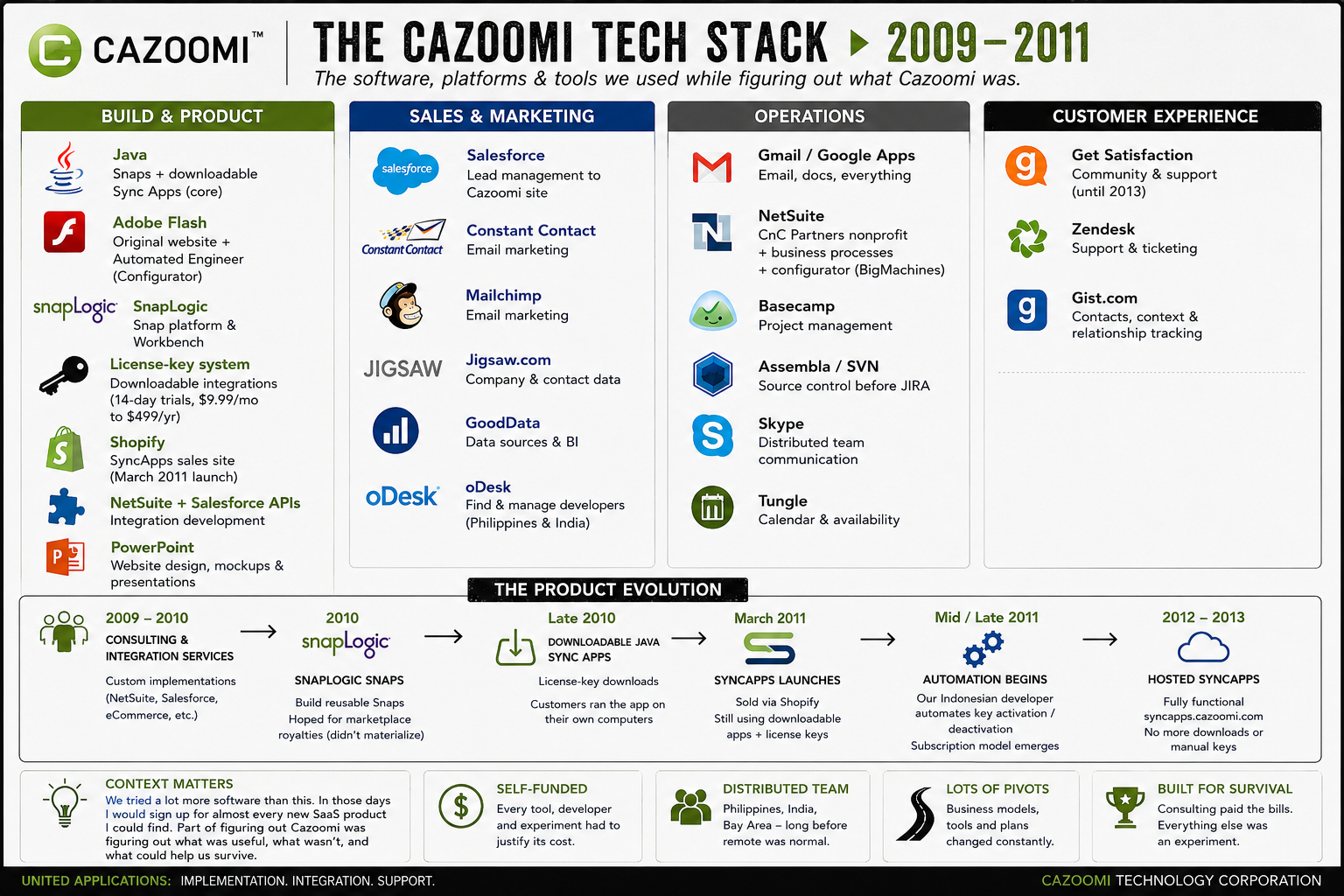
There was no big relaunch, venture round or TechCrunch story. It was basically me, a genius developer from Indonesia, a few NetSuite and Salesforce consultants along with a few dozen overseas consultants doing whatever projects we could win, including integration work for a company called SnapLogic.
SnapLogic turned out to be important. At the time, the term iPaaS wasn’t something customers casually used in meetings. We were just trying to connect software, and SnapLogic had an interesting approach built around reusable integrations they called Snaps, which we became involved in creating and implementing.
Their CEO, who met with us when they brought us on as a partner, also had an enormous influence on me. I watched how he dealt with people in meetings and how smoothly he could get the requirements out of a conversation. I loved his style and learned from it.
The work itself was exactly what I liked. We’d talk to the customer, understand the process, figure out where the data needed to go, build it and then do it again for the next company. Except after enough projects, that last part started bothering me because it still felt like services work.
Why were we doing it again?
What If the Software Remembered?
Every implementation taught us something. We learned how Salesforce customers behaved, how NetSuite customers structured data, what marketers expected from their email platforms, where duplicates appeared, what happened when records changed, which system needed to own which field and all the strange edge cases nobody thought about until thousands of records started moving.
Then we’d finish the project, move to another customer and discover many of the same problems.
I began thinking that the knowledge itself was the valuable part. Why should the next customer pay consultants to rediscover everything we had just learned?
Why couldn’t the software remember?
That idea eventually became SyncApps®.
We started moving our thinking away from one-off integration projects and toward something repeatable. Instead of rebuilding every integration from scratch, we could capture the patterns and let customers configure them, and in March 2011 SyncApps launched.
I wish I could tell you that I knew immediately we’d found the answer, but I didn’t. I was still taking consulting and support work because I had bills to pay, while the Indonesian developer who had built all those Snaps with me at SnapLogic and, was now helping move those integrations to the cloud, was also spending about half his working time with another company so he could pay his bills.
Neither of us knew exactly what this was going to become.
That’s probably one of the things I remember most clearly about those early years. I didn’t wake up one morning and decide I was now a software founder. I woke up every morning trying to find enough work to keep Cazoomi alive long enough to discover what it might become.
Then People Started Showing Up
The strange thing about building something useful is that eventually people find it. We started getting attention from companies whose names were much larger than ours. Partners came to us, customers came to us, and the integrations we’d originally built because somebody had a specific problem began attracting other businesses with almost exactly the same problem.
Constant Contact became particularly important to us. They liked what we were doing, and over the next several years that relationship helped drive tremendous growth. Our subscriber base and revenue grew more than 50% year over year during parts of that period.
From the outside, this was probably the point where Cazoomi started looking successful.
Inside my life, things were considerably messier.
The Part Founder Stories Usually Clean Up
Between roughly 2009 and 2015, I made almost every mistake you can imagine. I was drinking heavily during parts of those years while simultaneously helping build one of our fastest-growing integrations. I would still wake up and work, run my usual 20k and answer customer support emails, and sometimes the team covered for me when I wasn’t functioning as well as I should have been.
The company could be having its best month ever while I was having a terrible month personally, and both things could be true at once.
I think founder stories lose something when we remove that part because personal life and business life aren’t neatly separated. We like timelines that make sense afterward: founder sees opportunity, founder builds product, customers arrive, revenue grows and founder succeeds.
Living through it doesn’t feel anything like that.
You’re building a company while also being a husband, father, friend, employee, customer, partner and whatever else life requires that week. Family influences decisions. Fear influences decisions. Money certainly influences decisions, and sometimes alcohol influenced mine.
There were jobs and opportunities during those years that I probably ended myself before somebody else could end them for me. I can see that now, but back then I simply knew I was uncomfortable and found a way out. Some of those decisions were good, some weren’t, and some I still regret.
Experience doesn’t change what happened. It just gives you enough distance to recognize the pattern.
We Thought Constant Contact Was Going to Buy Us
For years we believed Constant Contact might eventually acquire Cazoomi. That wasn’t some fantasy I invented after the fact. Constant Contact had become our largest partner, they liked what we were building, and their ecosystem helped us grow tremendously. By 2015 they had around 650,000 customers, while we were the little integration company growing alongside them.
So we positioned ourselves for what seemed like a logical ending. Then in November 2015 Constant Contact announced that someone else was buying them, with Endurance International agreeing to pay about $1.1 billion.
I remember what that meant to me much more than I remember the transaction itself.
They weren’t going to buy us.
For more than five years we had quietly imagined that Cazoomi might eventually become part of Constant Contact, and suddenly that future didn’t exist anymore. At the time it felt like we had lost our exit.
Looking back, I wonder if we actually escaped one.
Constant Contact had around 650,000 customers when the deal was announced. In the years that followed, its customer base contracted substantially even as new owners continued investing in the business and marketing it. Of course I didn’t know any of that in November 2015. All I knew was that the future I had planned around wasn’t going to happen.
So we kept Cazoomi, and that turned out to be one of the most important things that ever happened to us because it eventually gave me something I hadn’t really been planning for: freedom.
By then Cazoomi had become a real business. It didn’t need to be acquired to survive. We had customers, recurring revenue and a Philippine team that understood the platform, and I had another decision to make.
I moved to the Philippines.
What Success Eventually Looked Like
I haven’t really been active on social media for most of the years since SyncApps became successful, and I never had much interest in becoming the founder who spends his days telling everyone else how to build a company. I prefer listening. Give me a problem and I’ll usually start looking for the pattern, which is probably why Cazoomi suited me.
Over time the company became something I never really planned: a profitable, privately held software business that allowed me to work from almost anywhere. We never needed venture capital, stayed debt free and kept solving integration problems. Most importantly, it eventually gave me control over my time.
A couple of years ago another software founder asked me to describe what a fantastic day looked like. I started writing and realized the answer had very little to do with software.
It was waking up early with a cappuccino and the dogs nearby, doing whatever work needed my attention while the world was still quiet, training, spending time with my wife, writing, watching something together, walking the dogs in the afternoon and then going to sleep and doing it again.
He later asked what my older brother, who had passed away, would have thought about the life I’d built. My brother was the A student and I was the C student, and he was also an entrepreneur long before I became one.
I thought about the question for a while and eventually realized what I hoped the answer was:
He’d be happy to see me build something that went beyond me.
I still think about that.
So What Does Any of This Have to Do With AI?
Quite a lot, actually.
AI feels enormous right now because we’re standing inside the change, but I’ve felt versions of that before. I watched enterprise software move to the cloud, Salesforce and NetSuite change how businesses bought software, APIs become normal and integration become an industry with its own acronym, iPaaS. I also watched companies spend enormous amounts of money trying to automate processes that people had previously done by hand.
Now AI can write code, interpret documentation, answer questions and help people build things in minutes that once took days. That’s real, and I think it’s remarkable. It even helped me organize this series in months instead of years.
But here’s what seventeen years of integration work has taught me.
A customer can have the best AI in the world and still not know which system should own the customer record. Sales can still disagree with Marketing, Marketing can still disagree with Finance, and someone can still change an email address in one system and wonder why it didn’t change somewhere else.
Someone still has to decide what the business is actually trying to accomplish. AI may make the implementation dramatically easier, but it doesn’t automatically make the decision easier.
The Technology Changes. The Patterns Remain.
If I could go back to one of those board rooms in 2009 and give the younger version of myself some advice, I don’t think I’d tell him which technology to learn. I wouldn’t tell him to build SyncApps sooner or tell him which people to trust and which mistakes to avoid. He probably wouldn’t listen anyway.
I’d tell him to keep paying attention.
Listen to what people say when they describe their problems, notice when you’ve heard the same problem before, and pay attention to what changes and what doesn’t.
Technology tends to remove one kind of complexity and create another, and I think AI will do the same. That’s why I’m optimistic about it without believing every prediction made about it. The tools are getting extraordinarily powerful, but the humans using them are still humans.
Why I’m Writing These Notes Now
I stopped enjoying writing ordinary company blog posts a long time ago. There are only so many articles the internet needs comparing one integration platform with another or explaining ten reasons somebody should automate a business process, and AI can write those articles now, probably better than most of us.
What AI doesn’t have is my memory of sitting in that board room in 2010 and realizing a meeting had changed direction. It doesn’t know what it felt like to wonder whether Cazoomi would pay next month’s bills, wasn’t there when we launched SyncApps in March 2011 and didn’t answer customer support emails while the company was growing faster than my personal life could handle.
And it isn’t sitting here this morning listening to roosters while three dogs sleep nearby.
Those are the things I think are worth writing down, not because my story is particularly special, but because after enough years you start seeing patterns that weren’t visible while you were living through them.
Maybe another founder will recognize one. Maybe someone building a company today will realize that not knowing exactly where they’re going doesn’t mean they’re lost, or maybe somebody will simply enjoy the story.
That’s enough for me.
The sun is higher now, the coffee is gone and the dogs are beginning to wake up. The roosters, unfortunately, are still going, so it’s probably time to get on with the day.
See you in the next note.
Founder Notes is a series from Clint Wilson about building Cazoomi, the people and mistakes along the way, and the patterns that become easier to see after more than 25+ years in software.
You can read more about how Cazoomi began on Our Story page or read The Real Cost of Enterprise Integration, an article originally written in the early years of the company and revisited in 2026.