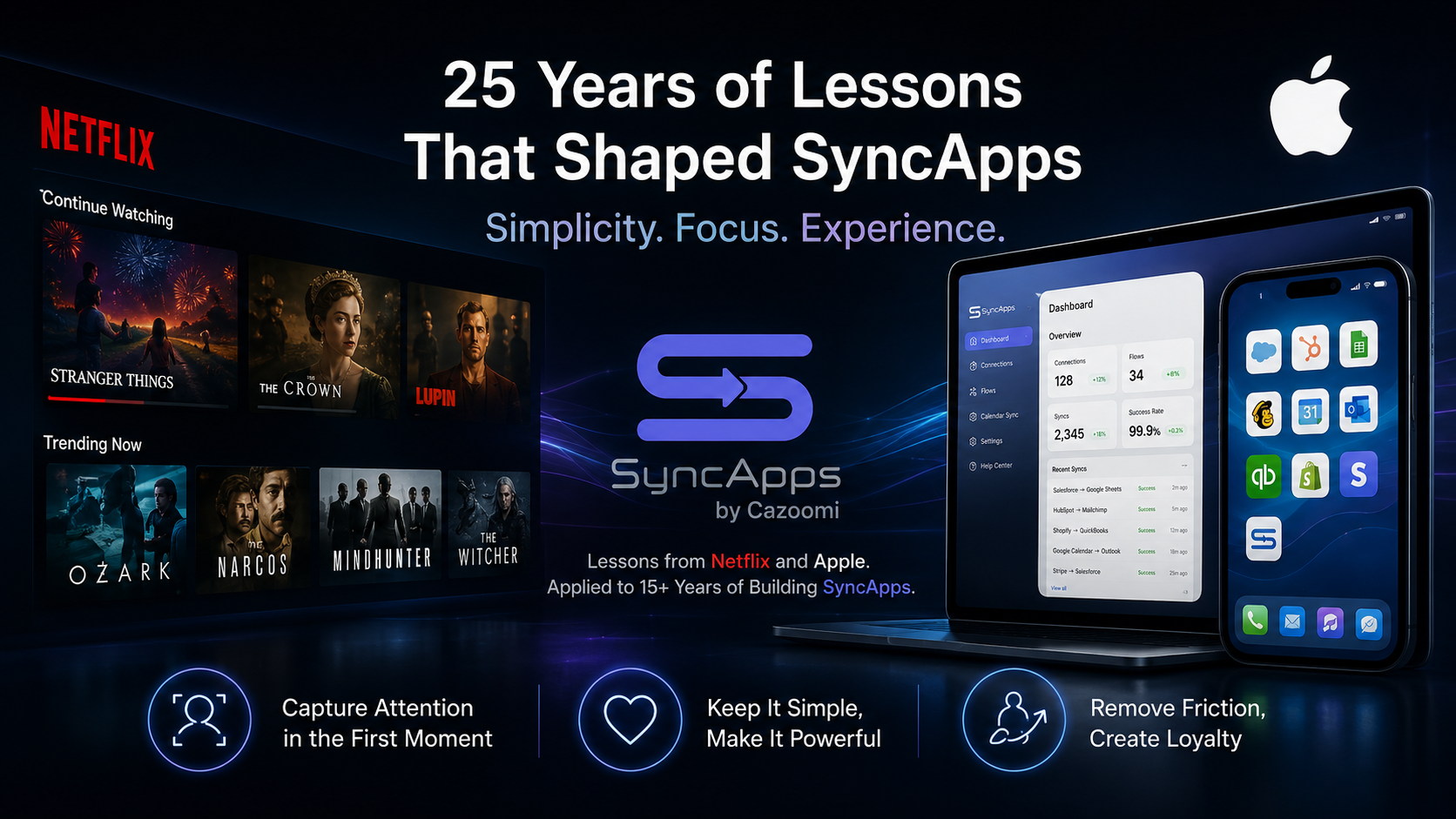
Over the past 25 years, I have watched one simple truth play out again and again in technology: the best products do not make customers think harder. They make the next step obvious.
That idea has shaped how I think about Cazoomi and SyncApps from day one.
In 2001, I remember sitting across from Netflix’s founder at Pentech Financial. Netflix was still early then. It was not the global streaming company people know today. It was still proving the DVD-by-mail model, still fighting for attention, and still building the customer habits that would later change entertainment.
Watching that journey unfold over the next two decades has been one of the more interesting business lessons of my life.
Netflix went from a focused, simple customer promise to a company worth hundreds of billions of dollars. It did not happen because the product was technically simple behind the scenes. It happened because the customer experience felt simple in front of the screen.
That is the part I paid attention to.
The harder lesson behind the Netflix memory
That 2001 Netflix memory stayed with me for more than just business reasons.
At the time, I also saw the harder side of startup financing up close. I saw how early-stage companies could be put under serious pressure while still trying to build something customers loved. I left that world not long after because I knew I did not want my life’s work tied to that kind of financing culture.
That experience shaped me.
It made me respect founders who could keep building through pressure. It also made me think differently about the kind of company I wanted Cazoomi to become. I did not want to build something dependent on hype, overfunding, or pressure from people far removed from the customer.
I wanted to build something useful, durable, and customer-funded.
That is one reason Netflix’s journey stayed with me. They survived the early stage, kept improving the experience, and eventually became one of the clearest examples of how a focused product can change customer behavior at global scale.
The lesson was never just entertainment
Netflix and Apple may seem far away from the world of CRM, email marketing, nonprofits, eCommerce, and data integration. But from a product-builder’s point of view, they taught the same lesson.
Apple showed that powerful technology could feel calm, direct, and human.
Netflix showed that a company could hide enormous operational complexity behind a simple interface that kept people moving.
That has always been the design challenge for SyncApps.
Data integration is complex. Field mapping is complex. Segmentation is complex. Sync logic is complex. Matching records, managing opt-outs, recovering bad data, and keeping systems aligned across Salesforce, Mailchimp, NetSuite, Constant Contact, and other platforms is not simple work.
But the customer should not have to feel all of that.
The customer should understand the value quickly.
They should know what the integration does.
They should know what to do next.
They should not have to fight the product before they trust it.
What Netflix taught me about above-the-fold thinking
For 15+ years, Netflix has been one of the best examples of above-the-fold execution.
The screen does not waste time. The value is immediate. The user sees the title, the visual, the preview, the call to action, and the next choice. The interface is designed around attention.
That matters because attention is the first conversion.
Before a customer reads a feature list, joins a demo, starts a trial, or buys a plan, they decide whether the page deserves more of their time.
That is where above-the-fold design matters.
At Cazoomi, this has influenced how we think about SyncApps pages and product flows. A visitor should not need to scroll five times to understand the point. The first screen should answer the basic questions:
The best above-the-fold experience does not say everything. It says the right thing first.
That is the Netflix lesson applied to B2B SaaS.
Watching the iPhone change everyday life
Apple’s influence was more personal.
I bought my daughter the very first iPhone, and then every year after that. So I did not just watch Apple from the outside as a technology company. I watched how the iPhone changed her daily life.
It changed how she communicated, learned, created, shared, searched, listened, watched, and moved through the world. The interface became second nature. The device became an extension of daily behavior.
That changed how I thought about software.
Apple trained people to expect technology to feel immediate. Clear. Visual. Responsive. Personal. The best interface no longer felt like software. It felt like the natural way to get something done.
That became part of my thinking for SyncApps.
Business software is not the same as an iPhone, but customer expectations do not stay in separate categories. Once people experience simplicity in their personal lives, they bring that expectation into their work.
They do not want business software that feels like a manual.
They want clarity.
They want speed.
They want the next step to be obvious.
They want the product to respect their time.
Apple made complexity feel premium
Apple influenced me in a different way, too.
Apple’s best product experiences do not feel like manuals. They feel like decisions have already been made for the customer. The layout, spacing, hierarchy, copy, and next action all work together to reduce doubt.
That matters in SaaS because doubt is expensive.
If a customer is unsure what a page means, they leave.
If a setup flow feels too technical, they delay.
If pricing feels confusing, they compare.
If support feels distant, they hesitate.
So the job is not only to build features. The job is to remove hesitation.
That is why Cazoomi has always tried to make SyncApps practical, accurate, affordable, and supported. Those are not just product ideas. They are trust signals.
The SyncApps version of simplicity
SyncApps does a lot behind the scenes.
It helps teams connect the systems they already depend on. It keeps customer, donor, subscriber, campaign, and financial data moving between platforms. It helps reduce manual exports, duplicate records, broken segmentation, and lost campaign history.
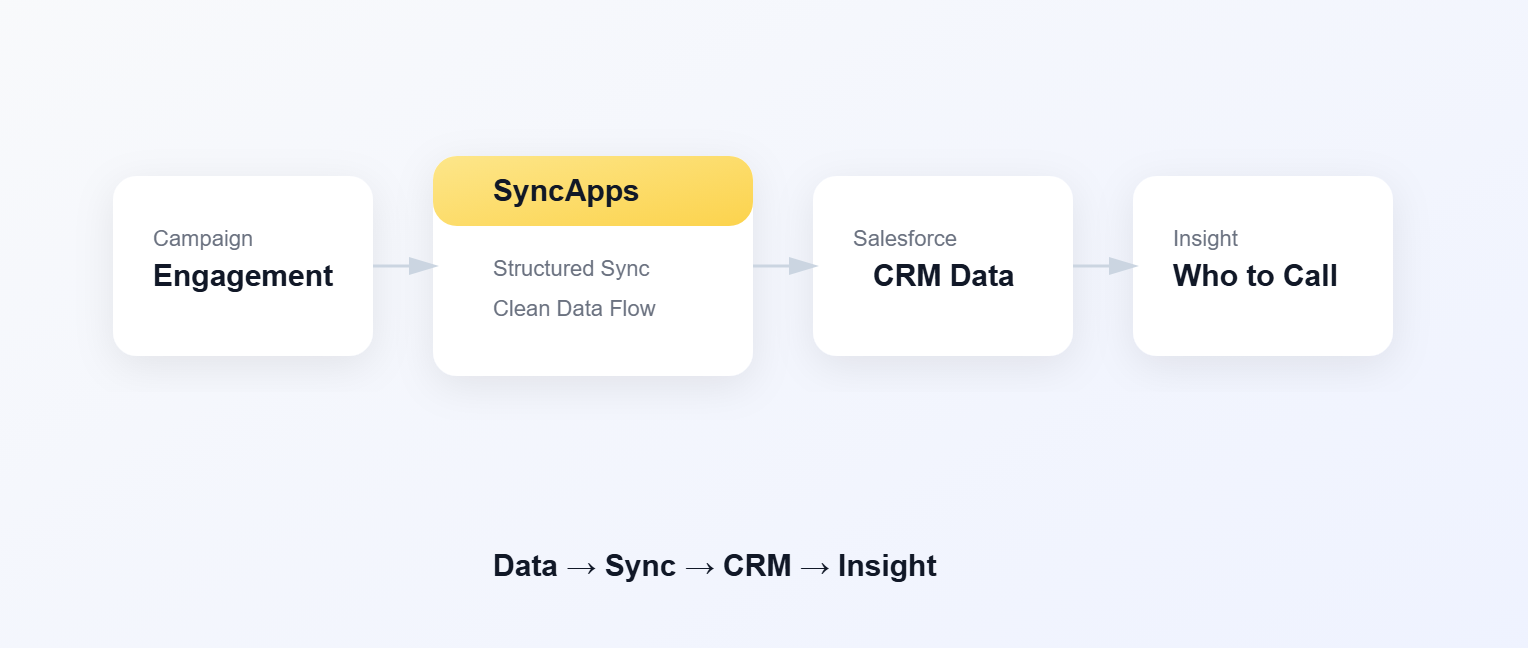
For example, a team using Salesforce and Mailchimp does not want to think about integration mechanics all day. They want accurate customer data, cleaner audiences, better segmentation, and campaign engagement flowing back where the team can use it.
The same is true for nonprofits using Idlewild’s Nonprofit Accelerator and Mailchimp. They do not want to export lists manually, lose donor context, or guess which supporters belong in which audience. They want the system to help them communicate better.
That is the real product.
The integration is the engine.
The outcome is confidence.
A 25-year journey back to one idea
Looking back, the journey from 2001 to today has been less about chasing technology trends and more about learning what stays true.
Customers reward simplicity.
Customers reward clarity.
Customers reward products that respect their time.
Netflix did that in entertainment. Apple did that in devices and software. Cazoomi has tried to bring that same thinking into business data integration.
Not by copying their products, but by learning from their discipline.
Show the value early.
Make the next step clear.
Hide the complexity where possible.
Support the customer when complexity cannot be avoided.
That has been the UI lesson, the product lesson, and the founder lesson.
After 15+ years of building SyncApps, I still believe the best software does not ask the customer to understand everything happening behind the scenes.
It simply helps them get the result they came for.
That is what Netflix and Apple taught me.
And that is still what we are building at Cazoomi.
See how SyncApps makes business data easier
Need to connect your CRM, marketing, eCommerce, finance, and nonprofit tools? Check out how organizations just like yours are solving, simple to complicated, real life problems using real-time SyncApps integration.